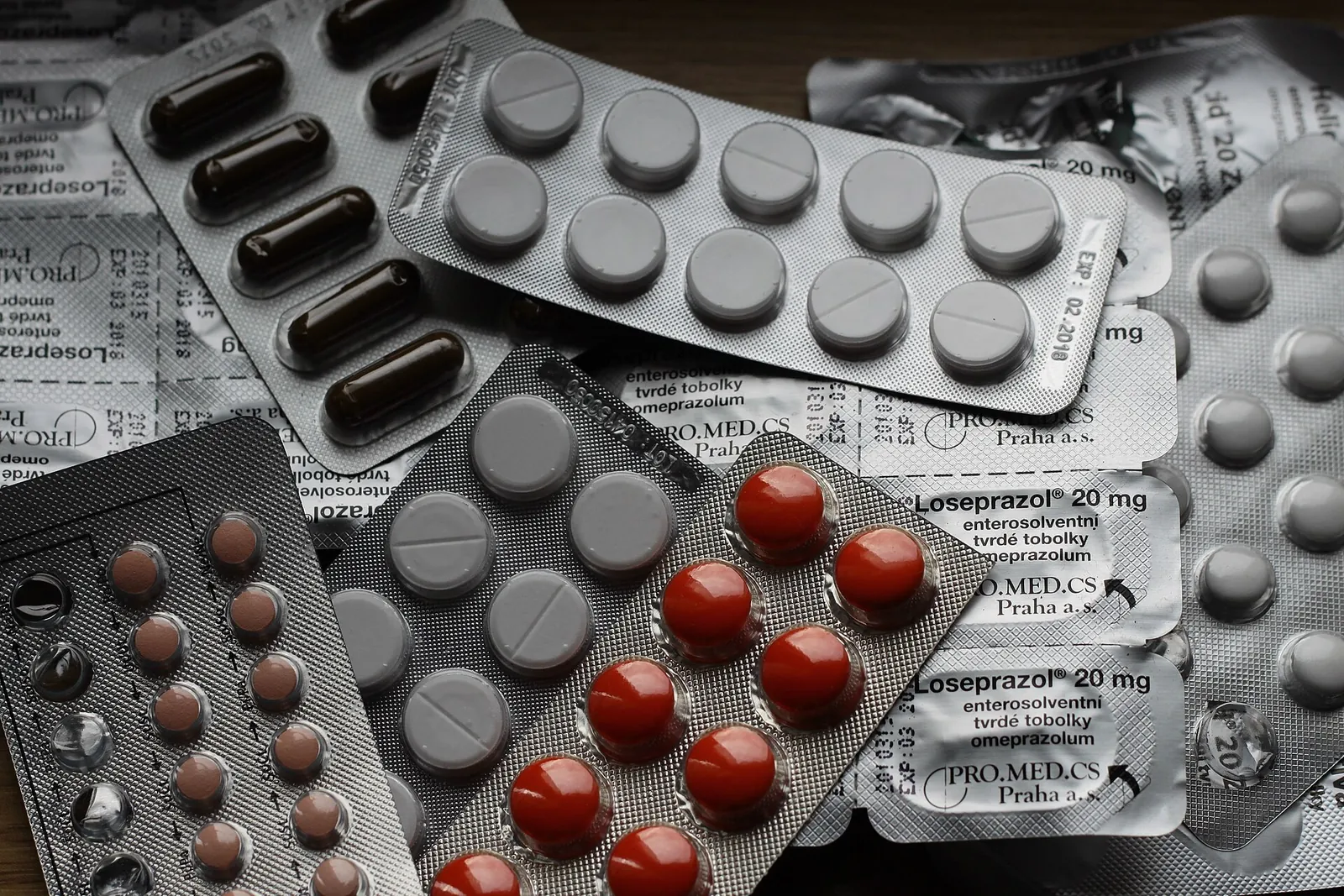
Photo: Pills in blister pack.jpg by Unknown author, CC0, via Wikimedia Commons. Cropped and colour-muted for display.
Section 34·11 items·9 October 2026
Household Medicines: Don't Let Them Hurt You
don't double up on acetaminophen, no aspirin, nimesulide or metamizole for children's fevers, who is at high risk of stomach damage from ibuprofen, don't give combination cold medicines to children under 2 on your own, don't take ibuprofen on your own after 20 weeks of pregnancy, omeprazole on your own for 7 days at most, no antibiotics for colds, rehydrate first for diarrhea and no antidiarrheals for children, taking too many painkillers actually causes headaches, put expired and leftover medicines in hazardous waste, no alcohol while taking cephalosporins or metronidazole and for 7 days after stopping. Outcome type: mortality.
A 3B 8C 0
Lifespan 11
Fever reducers, painkillers, cold medicines, stomach medicines, antidiarrheals: many of them you can buy on your own at a pharmacy. Being able to buy them without a prescription doesn't mean you can take them any way you like. This section doesn't cover which medicine to take for each illness; it picks only the few things where a single action avoids serious consequences.
All items use the mortality outcome type, which includes health endpoints such as liver failure, stomach bleeding and kidney failure in newborns. The benefit is mostly “one fewer serious accident”; studies cannot give a figure for “doing this cuts it by so many tenths,” so the size of the benefit is judged by how serious the consequences are, and each item's Notes say what the rating is based on.
For things already covered elsewhere, this section only points the way. For what to do first if someone swallows medicine or a cleaning product by mistake, see Section 13, Item 20 (accidental ingestion). For taking chronic-illness medicine fully as prescribed, see Section 16, Item 1 (take your medicine fully as prescribed). Buying prescription drugs online requires passing a prescription review first; see Section 28, Item 6 (get weight-loss drugs on prescription at a hospital).
The beneficiaries of the items in this section are you and your family, which belong to the top two tiers.
Sources are reproduced exactly as they appear in the Chinese original, including Chinese titles of laws and quoted statutory text. Original Chinese text of this section at upstream commit bb25081, on GitHub.
Before taking two cold medicines or painkillers together, read the ingredient lists; only one of them may contain acetaminophen (对乙酰氨基酚)
Value for cost Very high
In plain terms
Many cold medicines have acetaminophen mixed in, so taking two boxes together means taking a double dose, and an overdose damages the liver. In the United States, among patients with acute liver failure caused by it, nearly 30% died before they could get a liver transplant. Package inserts in China advise taking at most 2 grams a day, and don't drink alcohol while taking it either.
Cost
Free. A glance at the ingredient list on each box of medicine, a minute or two.
No moneyDone in passingNo willpowerBenefit size large
Benefit
Over 6 years, 22 US hospitals consecutively registered 662 cases of acute liver failure. Of these, 275 (42%) were caused by acetaminophen, with a median swallowed dose of 24 grams. Of these 275 people, 131 (48%) took too much by accident, not on purpose. Among those who took too much by accident, 38% were taking two or more medicines containing this ingredient at the same time. Of these 275 people, 27% died before they could get a liver transplant, and 8% had a liver transplant. In 2020 the National Medical Products Administration required over-the-counter package inserts to state that overuse can cause severe liver damage, and to recommend a maximum daily amount of no more than 2 grams. The inserts must also state that combining it with medicines containing acetaminophen or other antipyretic analgesics should be avoided as far as possible. US regulations require these over-the-counter drugs to state, as the first point of the warnings, three situations that harm the liver: exceeding the maximum daily amount, taking it with other medicines containing acetaminophen, and drinking 3 or more alcoholic drinks a day while using it.
Evidence grade
B
Notes
Acetaminophen is also called paracetamol (扑热息痛). Combination cold medicines whose generic name contains the two characters anfen (氨酚), such as acetaminophen and pseudoephedrine (氨酚伪麻) and acetaminophen, caffeine, artificial cow-bezoar and chlorphenamine (氨咖黄敏), contain this ingredient. If you're unsure, take all the boxes to a pharmacist at a drugstore. It is graded B because the US figures come from a case registry with no control group, so it is impossible to calculate how many incidents reading the ingredient list prevents. The benefit is rated “large” based on the consequences: in acute liver failure, nearly 30% die outright.
Don't use aspirin (阿司匹林), nimesulide (尼美舒利) or metamizole (安乃近) for a child's fever, and don't give minors cold medicines that contain metamizole either
Value for cost Very high
In plain terms
To bring down a child's fever, don't use any of these three drugs. Aspirin is linked to Reye's syndrome, a disease that damages the brain and the liver; in US statistics about 30% of affected children died, and after warnings were issued, cases fell by more than 90%. Nimesulide is contraindicated under age 12, and metamizole under age 18.
Cost
Free. When buying a fever reducer, glance at the generic name and the ingredient list.
No moneyDone in passingNo willpowerBenefit size large
Benefit
Reye's syndrome causes encephalopathy (brain disease) and fatty degeneration of the liver, usually after flu or chickenpox. In US national surveillance from 1981 to 1997, 1207 cases were reported in people under 18. In 82% of affected children, salicylate was detected in the blood; it is the ingredient of drugs like aspirin. The overall case fatality rate was 31%. Warnings about salicylate drugs began to be issued in 1980. That year 555 cases were reported, the peak; from 1987 on there were no more than 36 cases a year. In 2011 the State Food and Drug Administration ruled that oral nimesulide preparations must not be used in children under 12. In 2020 the National Medical Products Administration ruled that metamizole tablets are contraindicated in children and adolescents under 18. Compound artemisia and metamizole tablets (复方青蒿安乃近片), Zhongganling tablets (重感灵片) and Zhongganling capsules (重感灵胶囊), which contain metamizole, are likewise contraindicated under 18.
Evidence grade
B
Notes
Metamizole is not a first-choice drug for adults either. Its package insert states that it may cause agranulocytosis, aplastic anemia and anaphylactic shock, and that it is to be used only short term when the illness is acute and severe and no other effective drug is available. Zhongganling sounds like an ordinary cold medicine by its name, but it contains metamizole. For which fever reducer a child should take and how much by body weight, ask a pediatrician or a pharmacist. A baby under 3 months old with a fever goes straight to the hospital; see Section 20, Item 8 (go straight to the hospital at 38 ℃). It is graded B because the Reye's syndrome figures come from surveillance reports; the drop in cases and the issuing of the warnings are a matter of one following the other in time, not a controlled trial. The benefit is rated “large” because after the warnings, cases fell from 555 a year to 36 or fewer.
If you are over 60, have had stomach bleeding, or take anticoagulants or steroids, ask a doctor before taking painkillers like ibuprofen (布洛芬)
Value for cost Very high
In plain terms
Painkillers like ibuprofen, naproxen (萘普生) and aspirin (阿司匹林) can damage the stomach. In high-dose trials, people taking ibuprofen had about 4 times the risk of stomach bleeding or perforation of people not taking it. The risk is higher for people who are older, have had stomach bleeding, are also taking anticoagulants or steroids, or drink alcohol every day.
Cost
Free. Ask a doctor or pharmacist once.
No moneyDone in passingNo willpowerBenefit size large
Benefit
These drugs are called nonsteroidal anti-inflammatory drugs (NSAIDs); common ones include ibuprofen, naproxen and diclofenac (双氯芬酸). A meta-analysis pooled 280 randomized trials of these drugs against placebo, with 124513 people in total. Compared with placebo, the risk of upper gastrointestinal perforation, obstruction or bleeding was: ibuprofen RR 3.97 (95% CI 2.22–7.10, about 4 times), naproxen 4.22 (2.71–6.56), diclofenac 1.89 (1.16–3.09). All drugs of this type roughly doubled the risk of heart failure. US regulations require these over-the-counter drugs to carry a stomach bleeding warning. The warning lists six groups at higher risk: people aged 60 or over; people who have had a stomach ulcer or bleeding; people taking anticoagulants or steroids; people also taking other drugs of this type; people who drink 3 or more alcoholic drinks a day while using the drug; and people who take more of it, or for longer, than the label says.
Evidence grade
A
Notes
The paper's conclusions concern high-dose use. For the risk of taking it occasionally for a day or two at the label dose, this paper gives no separate figure. Many combination cold medicines also contain ingredients of this type, so taking them together with a painkiller doubles up; read the ingredient lists first. If your doctor has you taking low-dose aspirin long term to prevent blood clots, don't stop it on your own, and don't add another painkiller on your own either. For how to use these drugs for period pain and when to get checked by a gynecologist, see Section 3, Item 25 (for period pain, take a painkiller like ibuprofen).
When a child under 2 has a cold, don't give combination cold medicines or cough medicines on your own
Value for cost High
In plain terms
The National Medical Products Administration requires 14 children's combination cold medicines to carry a warning: parents are advised not to give them to children under 2 on their own, and they should be used under the guidance of a doctor or pharmacist. In trials done in children, cough medicines and anti-allergy medicines worked no better than placebo.
Cost
Free, and it also saves the money for the medicine.
No moneyDone in passingNo willpowerBenefit size medium
Benefit
National Medical Products Administration Announcement No. 57 of 2021 revised the package inserts of 14 products, including acetaminophen, pseudoephedrine and dextromethorphan oral solution (氨酚麻美口服溶液), children's acetaminophen, artificial cow-bezoar and chlorphenamine granules (小儿氨酚黄那敏颗粒), and children's acetaminophen and amantadine granules (小儿氨酚烷胺颗粒). The new warning reads “Parents or guardians are not advised to give this product to infants and young children under 2 on their own; it should be used under the guidance of a physician or pharmacist.” The precautions added “It should be used strictly according to the usage and dosage in the package insert, to avoid overdose.” They also added “Concurrent use of cold medicines containing the same or similar active ingredients should be avoided.” A Cochrane systematic review included 29 randomized controlled trials, 10 of them done in children. In the children's trials, none of these types of drugs was better than placebo: cough suppressants (antitussives); antihistamines (anti-allergy ingredients); antihistamines plus decongestants (ingredients that clear the nose); and cough suppressants plus bronchodilators. 21 studies reported adverse effects; preparations containing antihistamines and dextromethorphan (右美沙芬) had more adverse effects.
Evidence grade
B
Notes
Many of these 14 have anfen (氨酚) in their names and also contain acetaminophen (对乙酰氨基酚), so taking them together with a fever reducer doubles up; see Item 1 of this section (acetaminophen). One trial in that review found honey better than placebo, but honey must not be given to babies under 1 year old; see Section 20, Item 6 (honey). It is graded B because there were few trials for each type of drug in the review, and the authors did not pool them into a figure. The benefit is rated “medium” as a judgment: these drugs have no proven benefit for young children, and the risk is mainly overdose and duplicated ingredients.
After 20 weeks of pregnancy, don't take painkillers like ibuprofen (布洛芬) on your own
Value for cost High
In plain terms
After 20 weeks of pregnancy, most of the amniotic fluid is made by the fetus's kidneys. Taking drugs like ibuprofen at this point may damage the fetus's kidneys and reduce the amniotic fluid. Among such reports received in the United States, there were cases of newborn death. Low-dose aspirin (阿司匹林) prescribed by a doctor is not included.
Cost
Free.
No moneyDone in passingNo willpowerBenefit size medium
Benefit
The US Food and Drug Administration (FDA) issued a safety warning in October 2020. Using nonsteroidal anti-inflammatory drugs (NSAIDs) at about 20 weeks of pregnancy or later may cause kidney problems in the fetus, leading to low amniotic fluid. The warning covers both prescription and over-the-counter drugs, including aspirin, ibuprofen, naproxen (萘普生), diclofenac (双氯芬酸) and celecoxib (塞来昔布). The FDA reviewed adverse event reports up to July 2017 and found 35 cases of low amniotic fluid or newborn kidney impairment, all with serious outcomes. Among them were 5 newborn deaths, all accompanied by newborn kidney failure. In the published literature, most cases of low amniotic fluid resolved within 72 hours to 6 days after stopping the drug. The FDA recommends that pregnant women not use these drugs after 20 weeks unless a doctor specifically advises it. Low-dose 81 mg aspirin prescribed by a doctor to treat specific problems in pregnancy is not subject to this restriction. When pain relief or fever reduction is needed, the FDA mentions that other drugs such as acetaminophen (对乙酰氨基酚) can be used; ask a pharmacist or doctor first.
Evidence grade
B
Notes
The FDA warns that many over-the-counter medicines for colds, flu and insomnia also contain ingredients of this type, so read the ingredient list. US over-the-counter labels used to warn only about the last 3 months of pregnancy; this time the line was moved earlier, to around 20 weeks. For low-dose aspirin to prevent preeclampsia, see Section 27, Item 5 (low-dose aspirin). It is graded B because the figures come from adverse event reports; how many people took the drug without anything happening is unknown. The benefit is rated “medium” as a judgment: the outcomes are serious, but they happen rarely.
If you buy omeprazole (奥美拉唑) yourself for acid reflux and heartburn, take it for at most 7 days; with difficulty swallowing, vomiting blood or black stools, go straight to the hospital
Value for cost High
In plain terms
Omeprazole enteric-coated tablets can be bought without a prescription since 2022, but the package insert states that you should take it on your own for no more than 7 days, and not take it again within two months. Don't take it on your own if you have difficulty or pain swallowing, vomit blood, or have bloody or black stools; these may be signs of a serious condition. The drug may also mask the symptoms of stomach cancer and delay diagnosis.
Cost
Free. Take it for the number of days the package insert says.
No moneyDone in passingNo willpowerBenefit size medium
Benefit
National Medical Products Administration Announcement No. 68 of 2022 switched omeprazole enteric-coated tablets from prescription to over-the-counter status, and at the same time issued a model package insert. The indication written in the model is “short-term relief of heartburn and acid reflux symptoms caused by excess stomach acid.” The precautions state: do not use for more than 7 days, and if symptoms are not relieved, consult a physician or pharmacist. Do not take it again within two months; if symptoms recur, seek medical care immediately. Do not use it if you have difficulty or pain swallowing, vomit blood, or have bloody or black stools; these may be signs of a serious condition. When alarm symptoms such as marked weight loss, repeated vomiting, difficulty swallowing, vomiting blood or black stools appear, malignancy must first be ruled out, because treatment may mask symptoms and delay diagnosis. People aged 55 or over with new symptoms or a change in symptoms should consult a doctor. People taking clopidogrel (氯吡格雷) should avoid taking omeprazole at the same time.
Evidence grade
B
Notes
Clopidogrel is an anti-clotting drug commonly taken by people who have had a stent placed or have had a heart attack. Omeprazole makes it weaker; if you are taking it, ask your doctor first. It is graded B because these are package insert requirements, and no study has calculated how many incidents following them prevents. The benefit is rated “medium” as a judgment: what it prevents is stomach bleeding or stomach cancer being caught late, but most acid reflux and heartburn is not serious.
Don't ask the doctor for antibiotics for a common cold
Value for cost High
In plain terms
Taking antibiotics for a cold doesn't make you get better any faster than not taking them. For adults who take them, the risk of side effects is more than twice that of not taking them. For a pus-like runny nose lasting under 10 days, antibiotics have no definite benefit either.
Cost
Free, and it also saves money on medicine.
No moneyDone in passingNo willpowerBenefit size medium
Benefit
A Cochrane systematic review pooled 6 randomized trials with 1147 people. Comparing antibiotics with placebo for colds, there was no clear difference in the proportion not cured or with persisting symptoms (RR 0.83, 95% CI 0.60–1.14, the difference is not statistically significant). The risk of adverse effects was 1.8 times that of the placebo group (95% CI 1.01–3.21). Of this, in adults it was 2.62 times (1.32–5.18); in children there was no increase (0.91, 0.51–1.63). For acute purulent rhinitis, a pus-like runny nose lasting under 10 days, antibiotics also had no clear benefit (RR 0.73, 0.47–1.13). Adverse effects, however, increased (RR 1.46, 1.10–1.94, about 46% higher). The authors' conclusion: routine antibiotic use is not recommended in either situation.
Evidence grade
A
Notes
This version was republished in 2025; the abstract states that the literature search ran up to 2013. Antibiotics are prescription drugs in China, and pharmacies must sell them only with a prescription; don't take leftover antibiotics at home on your own either. The benefit is rated “medium” as a judgment: what it prevents is adverse effects, not death.
Sources
Kenealy T, Arroll B (2025). Antibiotics for the common cold and acute purulent rhinitis. Cochrane Database of Systematic Reviews, 11:CD000247. https://doi.org/10.1002/14651858.CD000247.pub4
With diarrhea, first replace fluids with oral rehydration salts; don't give antidiarrheal drugs to children under 5
Value for cost Standard
In plain terms
With diarrhea, the most important thing is to replace fluids, not to stop the diarrhea. Mix oral rehydration salts with water as the instructions say and drink them; don't substitute fruit juice drinks, which are too sweet and actually leave you more dehydrated. Don't give children under 5 antidiarrheal drugs like loperamide (洛哌丁胺); in severe cases they cause intestinal obstruction, which can be fatal.
Cost
A box of oral rehydration salts costs from a few yuan to a dozen or so yuan; keep a box at home.
A little moneyDone in passingNo willpowerBenefit size medium
Benefit
The World Health Organization's diarrhea treatment manual states that “antidiarrheal” drugs and anti-vomiting drugs have no practical benefit for acute or persistent diarrhea in children. They do not prevent dehydration, nor do they improve nutrition. Some have dangerous, sometimes fatal, side effects; they must never be given to children under 5. Drugs like loperamide that slow the movement of the gut may cause severe paralytic ileus, which can be fatal, and may also prolong infection. The manual also states that drinks with too much sugar draw water from the body into the gut, causing hypernatremic dehydration; examples are soft drinks and commercial fruit juice drinks. What the WHO manual recommends is the reduced-osmolarity formula, with a total osmolarity of 245 mOsm/L. Compared with the old formula, it cut unscheduled intravenous infusions by 33%. A Cochrane review pooling 8 trials found a similar result (OR 0.59, 95% CI 0.45–0.79, about 40% fewer).
Evidence grade
A
Notes
When buying, check the osmolarity on the package insert and choose a reduced-osmolarity formula. The manual states that blood in a child's stool is most likely bacterial dysentery, which needs a doctor and antibiotics; rehydrating at home alone is not enough. The benefit is rated “medium” as a judgment: the figures at hand compare two kinds of rehydration salts, not drinking them versus not drinking them.
Sources
World Health Organization (2005). The treatment of diarrhoea: a manual for physicians and other senior health workers, 4th revision. https://iris.who.int/handle/10665/43209;Hahn S, Kim S, Garner P (2002). Reduced osmolarity oral rehydration solution for treating dehydration caused by acute diarrhoea in children. Cochrane Database of Systematic Reviews, (1):CD002847. https://doi.org/10.1002/14651858.CD002847
Don't take painkillers on more than 15 days a month, or combination painkillers on more than 10 days, or your headaches may be caused by the medicine itself
Value for cost Standard
In plain terms
If you get headaches often and take painkillers every day, the more you take, the worse the pain may get. The international headache classification calls this medication-overuse headache. Taking ordinary painkillers on 15 or more days a month, or combination painkillers on 10 or more days, for more than 3 months in a row, is enough to qualify. Most people get better after stopping the medicine they were overusing.
Cost
Free. You need to keep track of the days you take them, and resist taking them casually.
No moneyDone in passingSome willpowerBenefit size medium
Benefit
The International Headache Society's International Classification of Headache Disorders (国际头痛疾病分类), 3rd edition, gives the diagnostic criteria. A person who already has a headache disorder has headache on 15 or more days a month, while regularly overusing headache medicine for more than 3 months. For non-opioid painkillers like acetaminophen (对乙酰氨基酚), aspirin (阿司匹林) and ibuprofen (布洛芬), the overuse threshold is 15 or more days a month. For combination painkillers, the threshold is 10 or more days a month. Combination painkillers means two or more classes of drugs with pain-relieving effects combined, or with an added helper ingredient such as caffeine, for example acetaminophen plus codeine (可待因). When several non-opioid painkillers are taken in rotation, the days are added together. The classification's comments state that epidemiological evidence from several countries shows that among people with headache on 15 or more days a month, more than half have this type of headache. Most patients improve after stopping the overused medicine, and preventive headache treatment also works better.
Evidence grade
B
Notes
Painkiller tablets with the character ka (咖) in the drug name usually have caffeine added, so count them as combination painkillers, at 10 days. If the number of headache days in a month keeps rising, see a neurologist; don't rely only on adding medicine. It is graded B because the classification gives diagnostic thresholds, not a controlled trial. The benefit is rated “medium” as a judgment: what it buys back is days with fewer headaches; it does not involve death.
Regularly clear out expired and unneeded leftover medicines and put them, packaging and all, in the hazardous waste bin; don't keep them at home
Value for cost Standard
In plain terms
Of the medicines children swallow by mistake behind adults' backs, nearly half are prescription tablets. Of the prescription medicines swallowed by mistake, about 30% belong to grandparents. Clearing out medicines you don't need means one less thing a child can dig up. Put the cleared-out medicines, packaging and all, in the hazardous waste bin, or hand them to a pharmacy that collects old medicines.
Cost
Free. Go through the medicine cabinet once a year, ten-odd minutes.
No moneyDone in passingNo willpowerBenefit size small
Benefit
US emergency department surveillance data estimate that from 2004 to 2013, unsupervised medicine swallowing by children under 6 led to about 640,000 emergency department visits (an estimated 640161). In 2013 alone there were about 59,000 (59092). From 2010 to 2013, the most common were oral prescription tablets, at 45.9%. Among prescription drugs, the most common were opioid painkillers (13.8%) and benzodiazepine sleeping pills and sedatives (12.7%). In 2017, 5 US poison control centers asked parents who called for help. Among children who swallowed prescription medicine, 30.7% had taken a grandparent's medicine. More than half (51.5%) of the prescription medicines had already been taken out of their original packaging by an adult before the child got hold of them. In China, the National Catalogue of Hazardous Wastes (2025 Edition) (国家危险废物名录(2025 年版)) lists waste medicines and their packaging produced in daily household life as hazardous waste within household waste. Shanghai's waste sorting and disposal guidelines classify waste medicines as hazardous waste, specifying that this includes expired medicines, medicine capsules, tablets and inner medicine packaging, and that “discarded medicines should preferably be disposed of together with their packaging.” Shanghai also stipulates that for expired and discarded medicines from residents' households collected by pharmacies, each district's market regulation department sets up temporary transfer points. The US FDA says the best way to dispose of expired and unneeded medicines is to take them to a take-back site.
Evidence grade
B
Notes
Waste-sorting catalogues are not exactly the same from place to place; go by the catalogue posted at your residential compound's garbage room. Shanghai classifies the dregs of Chinese herbal medicine as wet waste, not hazardous waste. Keep the medicines you hold on to in their original boxes, don't pour them into pill organizers or other bottles, and put them where children can't reach; see Section 13, Item 20 (accidental ingestion). Don't take leftover antibiotics at home on your own either; see Item 7 of this section (antibiotics). In the United States, when there is no take-back site, people are told to mix medicines into coffee grounds or cat litter, seal them in a bag and throw them in the regular trash, and a few strong painkillers may be flushed down the toilet. This is the US practice; in China, follow local sorting and disposal rules. It is graded B because those US figures are only records, and no study has calculated how many accidental ingestions clearing out the medicine cabinet prevents. The benefit is rated “small”: the figures at hand are emergency visits, not deaths, and the effect of the act of clearing out can't be calculated either.
While taking antibacterials like cephalosporins (头孢) or metronidazole (甲硝唑) and for 7 days after stopping, don't drink alcohol, and don't touch alcohol-containing medicines like Huoxiang Zhengqi liquid (藿香正气水) or cough syrup either
Value for cost Standard
In plain terms
When some cephalosporins and drugs like metronidazole meet alcohol, they can cause flushing, palpitations, chest tightness and vomiting, and in severe cases a drop in blood pressure. It's not only liquor and beer; alcohol-containing medicines like Huoxiang Zhengqi liquid and cough syrup can also cause it. Don't touch any of it from the time you are taking the drug until 7 days after stopping.
Cost
Free. Go without alcohol for a week or more, and before taking other medicines, check whether the ingredients include ethanol.
No moneyDone in passingSome willpowerBenefit size small
Benefit
This is called a disulfiram-like reaction. A 2023 safe-medication public education article from the Fujian Provincial Medical Products Administration says that drinking alcohol before or after taking some cephalosporin drugs may trigger this reaction, which “can seriously harm health and even endanger life.” Symptoms include facial flushing, sweating and palpitations, and even difficulty breathing, a drop in blood pressure and anaphylactic shock. The drugs the article lists, based on the Clinical Medication Guide of the Pharmacopoeia of the People's Republic of China (中华人民共和国药典临床用药须知), include cefazolin (头孢唑林), ceftriaxone (头孢曲松), cefoperazone (头孢哌酮), metronidazole, tinidazole (替硝唑), furazolidone (呋喃唑酮) and others. The article states “within 7 days after taking the medicine, drinking alcohol and consuming alcohol-containing medicines, foods and the like are prohibited,” with examples including liqueur-filled chocolates and Huoxiang Zhengqi liquid. The reason is that the enzyme the drug inhibits often takes 4 to 5 days to recover. A hospital in Guangzhou compiled 82 cases over 2 years. 57 cases (69.51%) were caused by cephalosporins and 10 (12.20%) by nitroimidazoles (drugs like metronidazole and tinidazole). The alcohol came from alcoholic drinks in 40 cases (48.78%) and from ethanol-containing medicines in 31 cases (37.80%). The oral ones included Huoxiang Zhengqi liquid, cough syrup, motherwort liquid extract (益母草流浸膏) and others. Of the 82 cases, 68 were mild, 9 moderate and 5 severe; they resolved within 1 to 3 hours, with no deaths. The US metronidazole label requires not drinking alcohol during use and for at least 3 days after stopping, and also not using products containing propylene glycol.
Evidence grade
B
Notes
Not every cephalosporin does this, but ordinary people can't tell them apart, so following this rule whichever one you take is the simplest. When a doctor prescribes a cephalosporin or metronidazole, mention on your own whether you have drunk alcohol in the past few days. That article suggests not drinking for 3 days before taking the medicine as well, while admitting that there is currently no authoritative word on this interval. As soon as you flush or feel palpitations, immediately stop anything containing alcohol. The article says mild cases can recover on their own, while severe ones need to be taken to the hospital. Don't drink alcohol while taking acetaminophen (对乙酰氨基酚) either; see Item 1 of this section (acetaminophen). It is graded B because the evidence is case compilations and package inserts, with no control group. The benefit is rated “small”: those 82 cases all recovered within a few hours, with no deaths, and only 5 were severe.